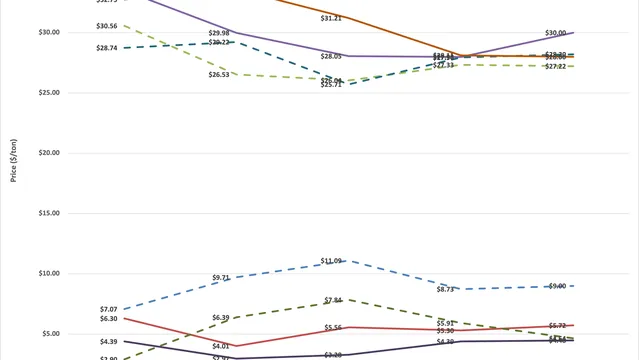
The North Carolina standing timber market continues to struggle, with third-quarter 2026 statewide prices down in three of the four product classes compared to the third quarter of 2025. Pulpwood is the only product class that saw statewide price gains, with pine pulpwood up 10% and hardwood pulpwood up 25% from a year ago. The greatest price decline occurred for pine chip-n-saw, which saw a 16% decrease, followed by pine sawtimber, which dropped 11%, and pine ply logs, which dropped 7%. Statewide prices for both oak and mixed hardwood sawtimber dropped by 4% and 9%, respectively.
Compared to just last quarter, pine pulpwood and sawtimber prices rose 5% and 3%, respectively, while pine chip-n-saw and ply logs dropped 3% and 4%, respectively. Hardwoods did not fare any better, with pulpwood down 11% and oak sawtimber down 7%. Mixed hardwood sawtimber prices remained flat compared to second-quarter 2026 prices.
When comparing the regional markets of Eastern and Western North Carolina, there are some noticeable differences. Eastern NC has seen very little change in its pine prices since the second quarter of 2026, with pine pulpwood increasing 3%, pine chip-n-saw by 1%, and pine sawtimber by less than 1%. Pine ply logs dropped by 10%. Hardwood prices fared much worse, with hardwood pulpwood dropping 21% and oak sawtimber dropping 10%. Mixed hardwood sawtimber remained relatively flat, with a less than 1% increase in price compared to second-quarter 2026 prices. Western North Carolina prices fared much better than those in Eastern North Carolina, with slight gains in pine pulpwood (up 8%) and pine sawtimber (up 7%). Pine ply logs remained flat (up less than 1%), and pine chip-n-saw decreased, dropping 6%. Hardwood prices did not fare any better, with pulpwood increasing by 2% and mixed hardwood and oak sawtimber decreasing by less than 1% and 3%, respectively.
Overall, things are not that much better for landowners this quarter compared to last quarter. Warmer weather and a lack of precipitation have made accessibility easier, but transportation challenges and higher diesel prices continue to adversely affect supply.
For information on third-quarter 2026 statewide average standing timber prices in North Carolina, please refer to the third-quarter price report.
It is important to note that timber prices can vary significantly based on numerous factors, including location,species, product type, accessibility, and distance to processing mills. Consequently, timber prices presented in general reports may not precisely reflect the standing timber values for a specific stand of trees or within a particular region of the state. Therefore, it is strongly recommended that stakeholders seek professional assistance for an accurate valuation of standing timber assets. For more information and resources on selling timber, visit the NC State Extension Forestry Timber Sales web page.